TSAGARADA
Tsagarada is a settlement in Thessaly, located on Mount Pelion within the Regional Unit of Magnesia.
It is situated on the eastern slopes of Mount Pelion at an altitude of 420 meters, approximately 46 kilometers east of Volos and 25 kilometers southeast of Zagora (the seat of the municipality). It is a traditional settlement and a popular tourist resort featuring numerous hotel facilities. Built in an area lush with beech and chestnut trees, it offers panoramic views of the Aegean Sea.
The village consists of four smaller settlements, named after the churches located in their central squares: Agioi Taxiarches—which is also the oldest settlement—Agia Paraskevi and Agios Stefanos, situated along the public road, and Agia Kyriaki, located lower down the mountain slope towards the sea.
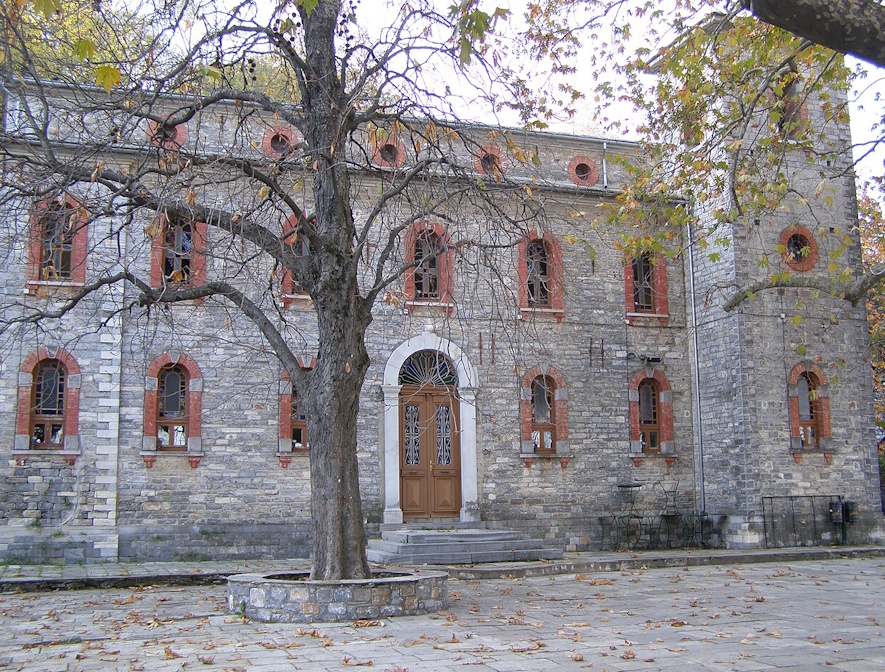 |
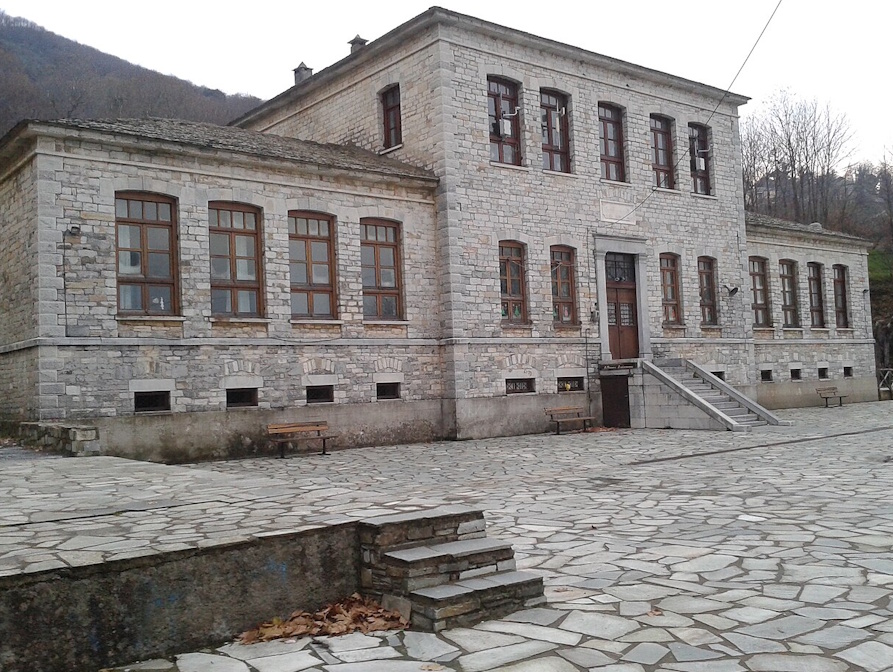 |
Left: The Church of Agia Paraskevi in Tsagarada
Right: The Nanopouleios School
Designation
The place name "Tsagarada" has given rise to various conflicting theories. The simplest explanation relates to shoes and is based on the fact that the village was once called "Tsagarades." Another theory relies on the etymology of foreign words—primarily Slavic—associated with a "beautiful view."Adraktas, a scholar from Tsagarada, believes that the place name derives from the word "Tsagaria," which in the dialect of itinerant Gypsies means "tents." Another theory suggests that the name "Tsagarada" originates from the Arabic word "tsagar," meaning "rock." Legend has it that Centaurs inhabited the mountain of Tsagarada in ancient times. It was also the site of the Gigantomachy and a favorite retreat for the Olympian gods. Gods, kings, and princes would travel to Mount Pelion to hunt. It was here that the mortal Peleus married the goddess Thetis, and where the first beauty contest took place among the stunning goddesses Hera, Athena, and Aphrodite.
Historical information
The construction of Tsagarada began around 1600; however, archaeological discoveries—such as ancient structures, tombs, and large storage jars—date back to around 1363. The region was also inhabited during the early Macedonian period and the Byzantine era. The first houses were built near the sea, but the fear of pirates prompted the population to settle at higher elevations. Furthermore, due to widespread poverty, the inhabitants of Tsagarada turned to handicrafts and small-scale manufacturing. A significant wave of emigration also occurred among the people of Eastern Pelion to cities in the East, notably Smyrna, Alexandria, and Constantinople.The Nanopouleios School was founded in 1909, taking its name from the benefactor Nikolaos Nanopoulos. In 1985, it was designated a Work of Art. Initially, it operated as a Commercial High School, but later it began to cater to primary education needs.
Secondary education was provided by the Achillopouleios Commercial School; built in 1864 through a donation from the Achillopoulos brothers—who had settled in Egypt—it was originally intended to house an urban school. It became a commercial school in 1905 (attracting students from all over Greece) and later operated as an educational facility for primary, junior high, and high school students until 1988, when the current building housing the Tsagarada Junior High and High School was constructed.
Administrative and demographic data
Following the incorporation of Thessaly into the Greek state, it is officially recorded as the seat of the then Municipality of Mouresi in 1883 and, in 1912, as the seat of the newly established community of the same name. From 1997 until 2010 (under the Kapodistrias Plan), it served as the seat of the Municipality of Mouresi. Under the Kallikratis Programme and its subsequent amendment, Kleisthenis I, it forms—together with Mylopotamos—the Community of Tsagarada, which falls under the Municipal Unit of Mouresi within the Municipality of Zagora-Mouresi; according to the 2011 census, it had a population of 525.
Architecture
A distinctive feature of Tsagarada is its unique architecture, known as the "Pelion style." This architectural tradition encompasses magnificent structures that bear the mark of the nobility and creative spirit of Tsagarada’s expatriates—ranging from public works, such as schools and churches, to grand mansions. Many of these buildings were commissioned by a generation of benefactors who, upon returning from life abroad, established impressive edifices. Notable examples include the Commercial School, the Nanopouleio, the Agioi Taxiarches aqueduct, and the construction of the road connecting Tsagarada and Milies.
Sights
Secret School
During the period of Ottoman rule, the "Secret School" (the small church of Panagia Megalomata) was situated halfway up a towering, precipitous rock face—buffeted by the wild waves of the Aegean Sea—near Fakistra Beach. From 1668 onwards, a monk lived there as an ascetic, teaching children in secret, away from the Turks. The cave still exists and is open to the public.
Old bridge
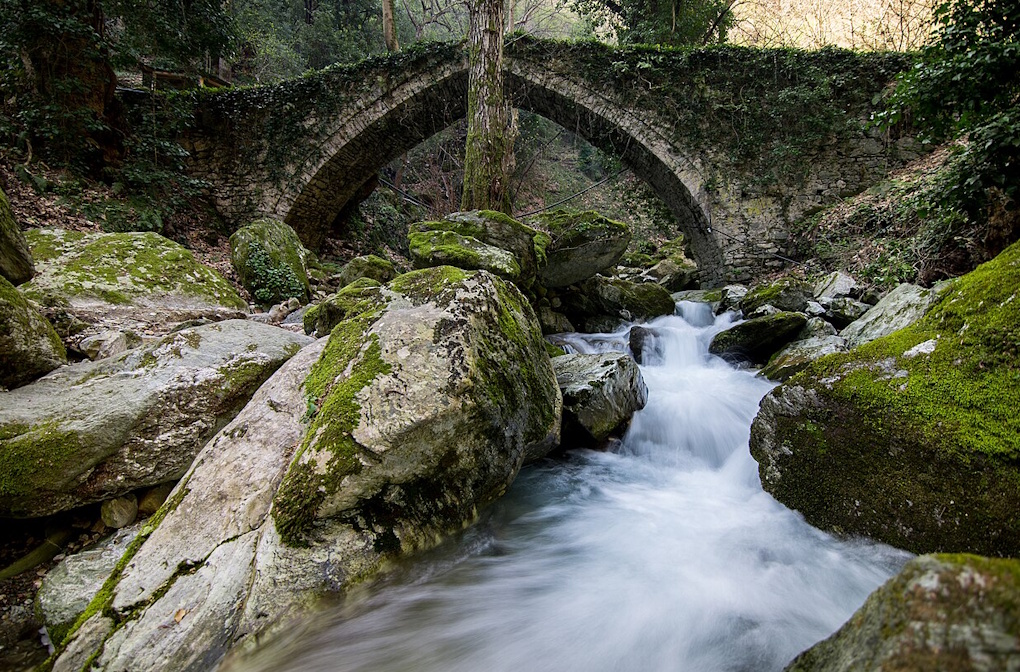
At the entrance to the village of Tsagarada stands the oldest and most well-known single-arch stone bridge. It was named after the year of its construction, 1728, and served as the only overland trade route of that era. It connects the villages of Tsagarada and Xourichti. The bridge is 18 meters long.
1,000-year-old plane tree
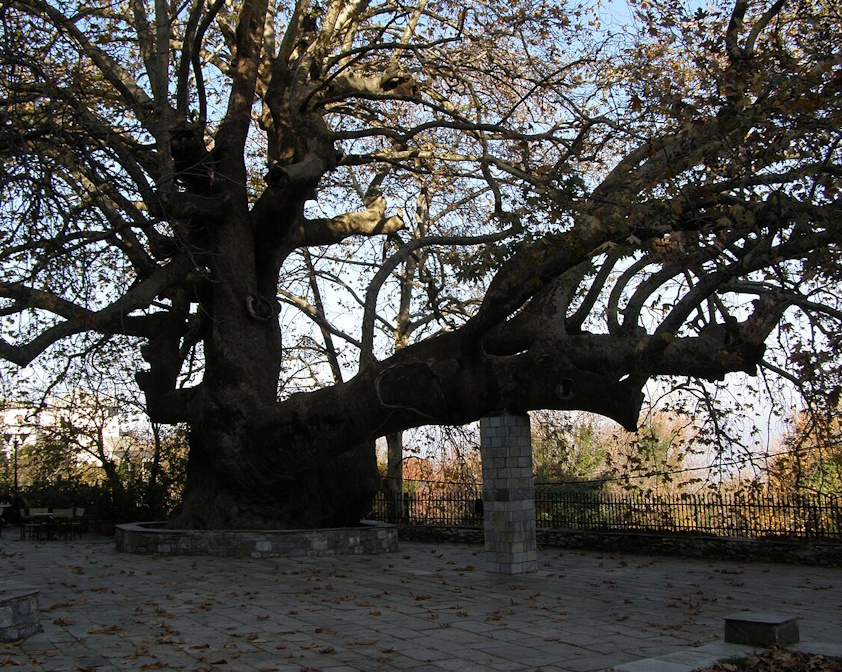
Η τουριστική ατραξιόν του χωριού είναι αναμφίβολα ο χιλιόχρονος πλάτανος στην πλατεία της Αγίας Παρασκευής. Ο κορμός του έχει περίμετρο 15 μέτρα, ενώ το καλοκαίρι η σκιά του καλύπτει ολόκληρη την πλατεία.
 |
 |
Left: The stone bridge of Tsagarada
Right: The thousand-year-old plane tree
Churches
Agia Paraskevi
In the central square of Tsagarada—home to the thousand-year-old plane tree—stands the Church of Agia Paraskevi, built in 1909 by the local benefactor Nikolaos Stakos. Its feast day is celebrated on July 26th, an occasion marked by a traditional village festival in the square. Regular services are held at the church every Sunday and on all religious holidays.
Saint Taxiarchis
The square and the Church of the Holy Archangels (Agioi Taxiarches) are located in the first district of Tsagarada. Of particular note is the Venetian-style iconostasis, which dates back to 1749. Its construction was completed three years after the church itself was built (1746). The church celebrates its feast day on September 6th.