VOLOS
Volos is a city in Thessaly, situated at the head of the Pagasetic Gulf, near the site of ancient Iolkos and at the foot of Mount Pelion, the home of the Centaurs. It is one of the largest cities and one of the most important ports in Greece. The patron saint of Volos is Saint Nicholas.
The city’s permanent population is 85,803, according to the 2021 census, whilst the population of the urban area stands at 129,737 (including the municipal districts of Volos, Nea Ionia, Iolkos, Aisonia and Agria).
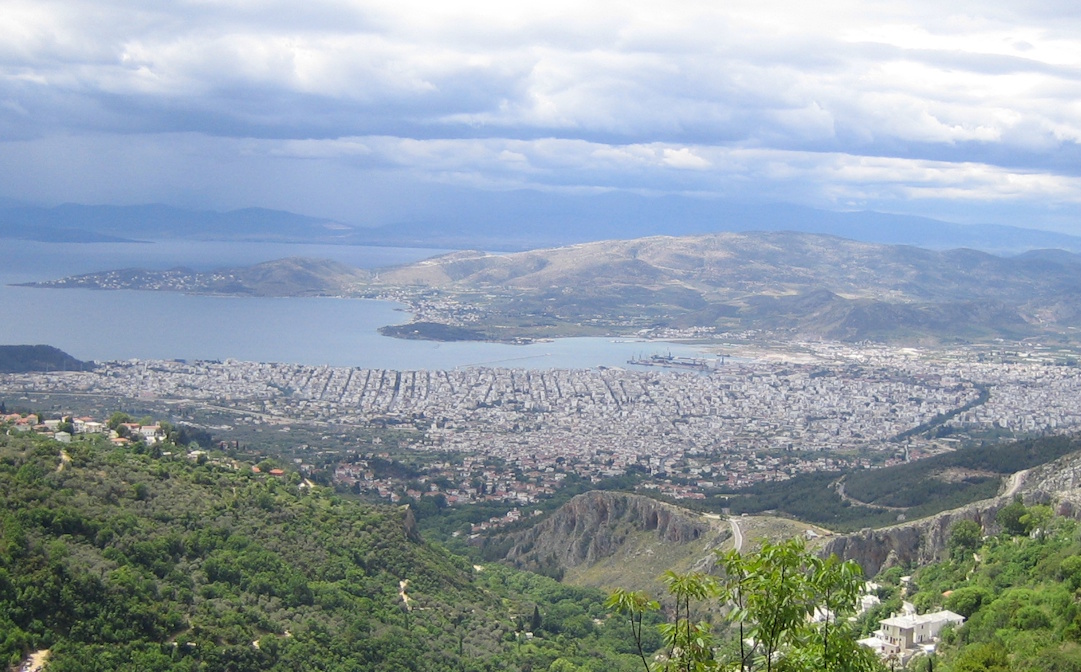 |
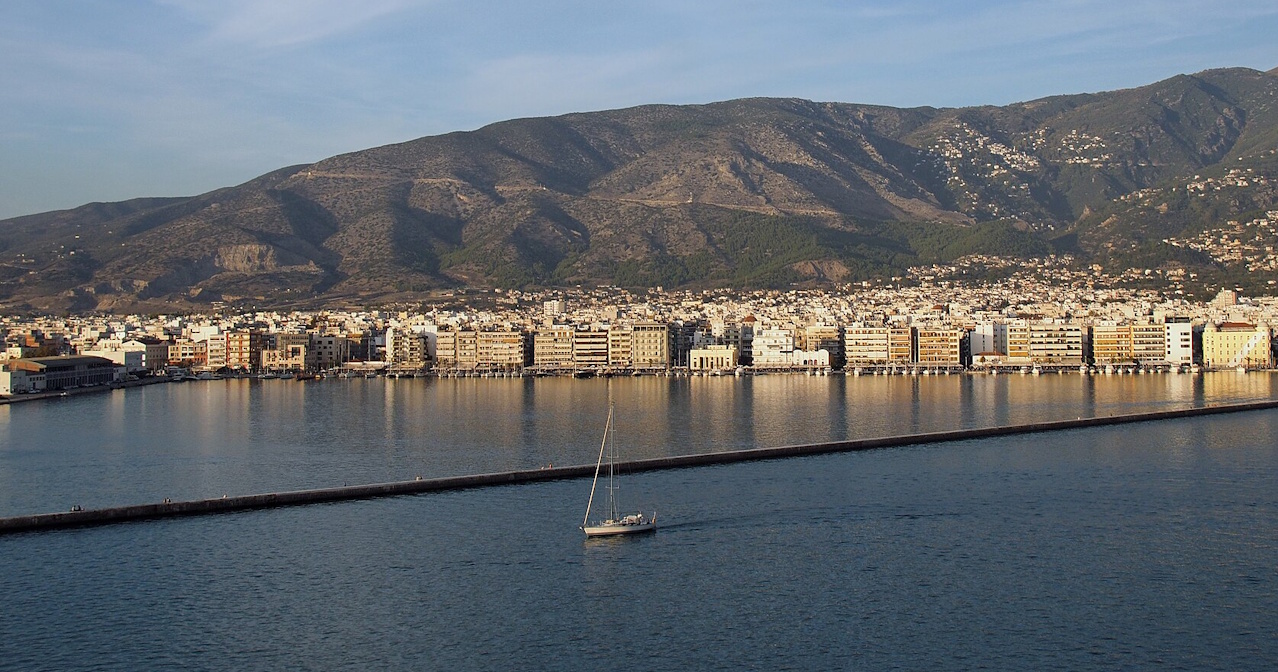 |
Left: View from Pelion
Right: The city of Volos
History
The Volos region, ancient Magnesia, is one of the earliest areas to have been settled in Greece. The settlements discovered in the nearby villages of Sesklo and Dimini date back to the 7th millennium BC, whilst the area has been continuously inhabited ever since.
Antiquité
The wider Volos area is home to some of the most significant Neolithic sites on the entire Balkan Peninsula. Archaeological investigations in the area have brought to light around forty Neolithic settlements (7th–8th millennium BC), several of which remained in use during the Chalcolithic period (3000–1500 BC) The most significant Neolithic settlements were discovered by the archaeologist Christos Tsountas in the early 20th century at Sesklo and Dimini. Excavations at these sites have revealed characteristic painted pottery, bone and stone tools, as well as objects made of obsidian sourced from Milos.Important Mycenaean sites have been discovered on the hill of Agioi Theodoroi, in what is now the Palia or Palaia neighbourhood, and in Pefkakia. The founding of Iolkos, an important economic and cultural centre of the region directly linked to the myth of the Argonautic expedition, dates back to the Mycenaean period. Earlier researchers believed that Iolkos was situated in Palia. However, more recent archaeological finds support the view that the seat of the kings of Iolkos was not in Palia, but in Dimini, which was then a coastal settlement. Two tablets inscribed with Linear B script were also found at the old castle in Palia, one of which bore legible symbols. These are the only Linear B tablets ever found in Thessaly. This was the centre of economic activity based on agriculture and livestock farming, whilst trade took place via the port at Pefkakia. During the Classical period (6th century BC), Pagases flourished; it was a port belonging to Pherae.
 |
 |
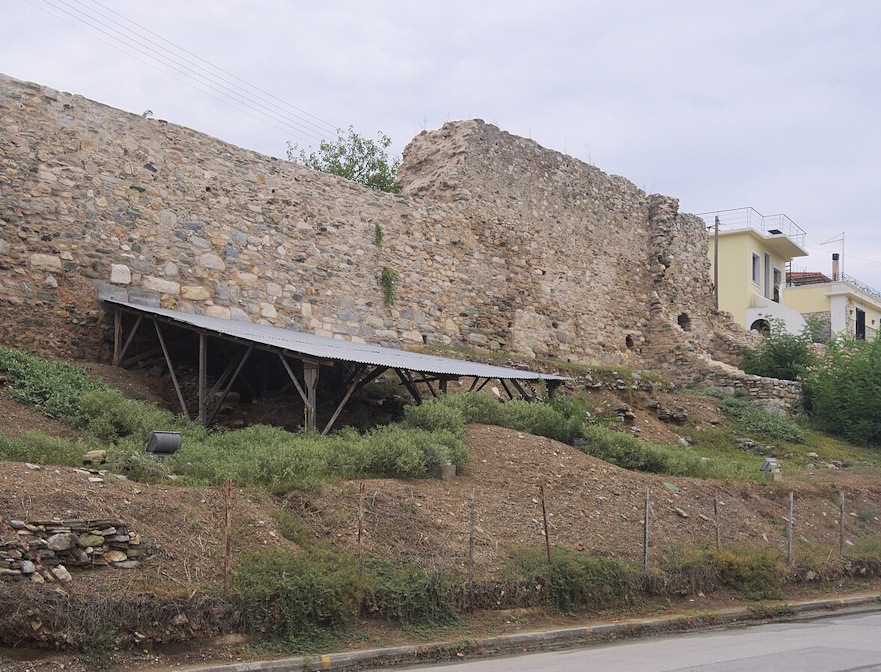
Left: The Volos Castle, in the Palia neighbourhood
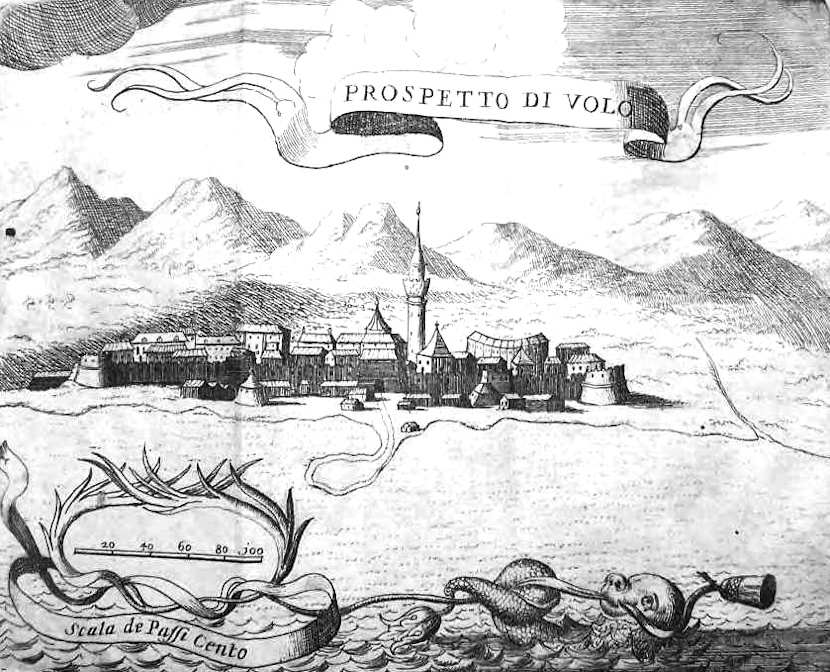
Right: The Ottoman castle of Volos in a 17th-century Italian engraving
In 293/292 BC, Demetrius the Besieger, King of Macedonia, founded the city of Demetriada (Demetrias) on the peninsula now known as Pefkakia, uniting Pagasa with various neighbouring villages. Dimitriada served as a powerful military garrison and base of operations for the Macedonians. At the same time, it developed into an important commercial centre during the period 217–168 BC. The city was built according to the Hippodamian plan and was surrounded by a strong wall. The palace was situated in the eastern part of the city, the marketplace to the south and the theatre to the west. Numerous funerary stelae have been found in the area, providing interesting insights into the economy, society and art of the period. In 197 BC, Demetriada fell into Roman hands.
From the early Christian period to the post-Byzantine era
Iolkos did not exist in the Byzantine Empire; in the early Middle Ages it was known as Demetriada, and continued to flourish during the Roman occupation. Together with Thebes in Phthiotis, near present-day Nea Anchialos, it was one of the most important centres of early Christian and Byzantine Thessaly, serving as the gateway from the interior to the sea. Indeed, from the 5th century AD, Demetriada became a bishopric, a title it retains to this day. In the 7th century, the Slavic Velegezites settled in the area. The Fthiotida Thebes were abandoned, whilst the inhabitants of Demetriada sought refuge on the hill of Agioi Theodoroi in Palia, where a settlement fortified by Emperor Justinian (551 AD) had previously existed. Over the following centuries, the city lost its importance, as it was vulnerable to attacks by Saracen pirates. Volos is first recorded under the name ‘Golos’ as one of the towns conquered by the Byzantine general John Monomachos in Thessaly.The name is of Slavic origin, deriving from the word ‘Gol’, which translates as ‘naked’, or the word ‘Gols’, which translates as ‘place of administration’. According to the Greek version, it took its name from the word ‘voli’ (meaning ‘cast’) because it was the place where fishermen cast their nets, or from the ‘volos’ (meaning ‘mound’ of earth); the new name ‘Volos’ first appeared in 1540. The medieval walls of Volos follow the route of the walls of ancient Iolkos; many finds from the ancient city are located on the medieval Acropolis. In 1204, following the Fall of Constantinople to the Crusaders, Demetrias was granted to the Melissinos, a distinguished Byzantine family, and specifically to its local branch. During that period of Latin rule, the Battle of Demetrias took place in the city’s harbour, between the Byzantines and the Latins. Volos, along with the whole of Thessaly, was conquered by the Serbian Empire (1348) and ruled by Preliub. Following Preliub’s death, Thessaly was ruled for a short period by Nikiforos II Orsini, followed by the Serbian governors Symeon Uresis Palaiologos and John Uresis Doukas Palaiologos. Upon the death of the latter (1373), Thessaly returned to Byzantine rule for 12 years, after which it was conquered by the Ottoman Empire under Sultan Bayezid I (1423). It was then that the Christian inhabitants began to abandon the coastal areas and migrate to the highlands of Pelion. Towards the end of the 16th century, the seat of the Bishop of Demetrias was moved to Ano Volos.
Ottoman rule
During the period of Ottoman rule, the region’s economic and intellectual activity shifted to Pelion, which benefited from the privileges granted to it by the Ottoman rulers. From the 17th century until the Greek Revolution of 1821, Pelion developed into one of the most important centres of early industry and intellectual life in Greece. During the same period, the castle of Volos was exclusively occupied by the Ottomans, and the settlement of Christians there was either prohibited or avoided.When the Greek Revolution of 1821 broke out, the villages of Pelion sided with the rebels, but the Turks managed, by force, to suppress the uprising within a year (1822). The castle of Volos was unsuccessfully besieged by ships from Hydra. Specifically, when the Turks learnt of the outbreak of the revolution in the Peloponnese, they barricaded themselves inside the castle, reinforced its ramparts with cannons and stocked up on supplies. On Thursday 5 May 1821, at six o’clock in the evening, ships led by Anastasios Tsamados of Hydra appeared — as he notes in his diary — at Agios Georgios and, following the proclamation of the revolution by Anthimos Gazis at Milies (7 March 1821), they joined forces with fighters from Pelion at the northern gate of the Castle. Their leader was Kyriakos Basdekis, who was wounded in the skirmishes with the Turks. The siege failed and the fleet withdrew on Wednesday 11 May, whilst at the same time Mahmut Pasha Dramali’s army arrived from Larissa. In 1827, the Battle of Volos took place, in which the Greek side was represented by the steam corvette ‘Karteria’, which was the world’s first steam-powered warship to take part in military operations.
The modern city of Volos began to be built outside the old castle shortly after 1830. According to local tradition, the first permanent dwelling in the modern city was the house of Nik. Gatsos, built in 1840. Volos, as the region’s port, attracted the attention of the people of Pelion, who initially rented space in the shops in the Old Town before they began setting up their businesses to the east of the castle. In 1841, the Tsougkou Halva Factory began operating, and in 1860 the first flour mill for the production of pasta was built in Volos by the Glavanis brothers. In 1869, Aristides Mousouris’s steam mill was built, and in 1872, the tannery of Georgios and Nikoulis. In the meantime, in 1856, the Metropolitan Church of Saint Nicholas was built.
In the years that followed, the city’s favourable geographical location, thanks to its harbour, contributed to its development as the economic centre of Thessaly.
Following the Russo-Turkish War of 1877 and the Congress of Constantinople (1881), Thessaly was ceded to Greece, and on 2 November 1881, the Greek Army entered the town of Volos.
During the ill-fated Greco-Turkish War of 1897, Volos fell once again into Turkish hands. The inhabitants of the area were forced to seek refuge on neighbouring islands, but after a few months the Turks withdrew and so the people of Volos and Pelion returned to their homes.
In recent times
Two years after the liberation of Thessaly, by royal decree of 31 March 1883 (Government Gazette 126), the Municipality of Pagasa was established, the predecessor of the present-day Municipality of Volos. The new town developed rapidly. The craft and agricultural traditions of Pelion, its port, and the capital from the diaspora that flowed into the region were some of the factors that fostered the town’s economic development, with trade and industry as its main drivers, whilst the town’s urban fabric expanded. The city’s favourable location and rapid economic growth attracted residents and investors from other regions. The brief occupation of Volos during the Greco-Turkish War of 1897 had no long-term impact on its development.In 1886, the railway link between Volos, Larissa and Kalambaka was completed. Also in 1895, the Volos–Lechonia railway line began operating, and was extended as far as Milies in 1904. At the same time, in 1892, work began on the development of the port, which continued even after the First World War, in order to meet the ever-increasing demands for the movement of goods. In 1919, the port of Volos was the leading exporter of tobacco in Greece, accounting for 30 per cent of exports.
By bringing together all the necessary conditions — capital, labour, an expanding domestic market and access to raw materials — Volos developed into a major industrial centre in the pre-war period. The main industrial sectors were food, metal, tobacco, textiles and tanning. In 1889, the Papariga ironworks was established, followed in 1890 by the Matsangos tobacco factory and, in 1895, the gasworks.
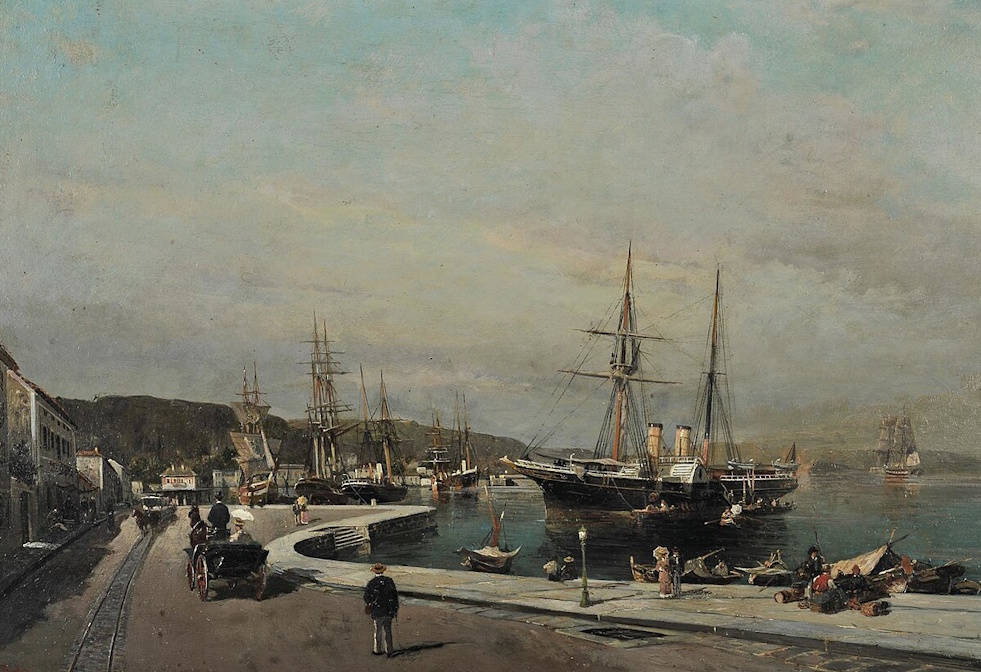 |
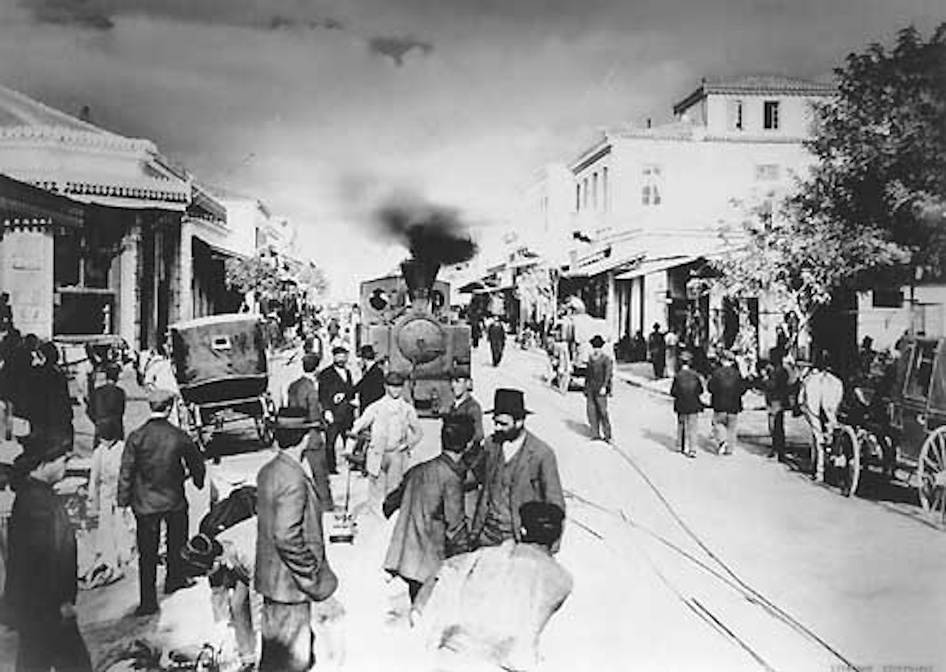 |
Left: K. Volanakis: The Port of Volos (1875?)
Right: Volos: Dimitriados Street in 1905
Alongside the economic boom, there was a flourishing of cultural and social activity. In 1894, the Municipal Theatre was founded, whilst in 1896 the Volos Gymnastics Club was established. In 1898, the newspaper Thessalia was launched as a successor to the newspapers Pagasai and Nea Thessalia, and it has been published almost without interruption to this day. In 1908, the Higher Primary School for Girls began operating, headed by the pioneering educator Alexandros Delmouzos, though it was to be forcibly closed just three years later. Also in 1908, the Volos Workers’ Centre was founded, the first of its kind in Greece. The economic boom of the new city of Volos also attracted people from other ethnic or religious groups. It is no coincidence that Volos has a Jewish synagogue and a Catholic church, both of which were built in the early 20th century. The famous Italian painter Giorgio de Chirico was also born in Volos; he was the son of the engineer Evaristo de Chirico, who designed the Volos–Mileon railway line.
Following the Asia Minor Catastrophe, many families from Asia Minor settled in the growing city of Volos, where, despite the great need for labour, they fell victim to widespread racism. The refugees from Asia Minor initially settled in the city’s vacant areas. Around Riga Fereou Square, they set up an entire shanty town, which was destroyed by fire in 1930. Gradually, the new residents of Volos moved to the north-western suburbs of the city, to Prosfigika, which later became the heart of Nea Ionia in Magnesia.
In 1937, industry in Volos began to show signs of decline, particularly in the iron and steel and textile sectors, whilst during the Second World War, the requisitioning of equipment forced many factories to operate at reduced capacity. Between 1941 and 1944, Volos suffered greatly under Italian and, later, German occupation. This was the only period during which the city’s population declined. Many members of resistance organisations, as well as ordinary civilians, met a tragic end on the city’s streets, at execution sites (such as Eleftherias Square) and at the Yellow Warehouse, which the Germans and their local collaborators used as a prison. The Jewish community of Volos, which suffered the second-lowest number of casualties after Kefalonia, thanks to the timely mobilisation of the EAM–ELAS, following the notification by Metropolitan Ioakeim of Demetrias to the Chief Rabbi of Volos, Moses Pesach, and the cooperation of the local authorities in evacuating citizens of Jewish origin from Volos, and also following the events in Thessaloniki (the deportation of the city’s Jewish population to concentration camps). (Today, the Jewish community numbers fewer than one hundred members, as most followed the post-war wave of emigration to settle in Israel or elsewhere.)
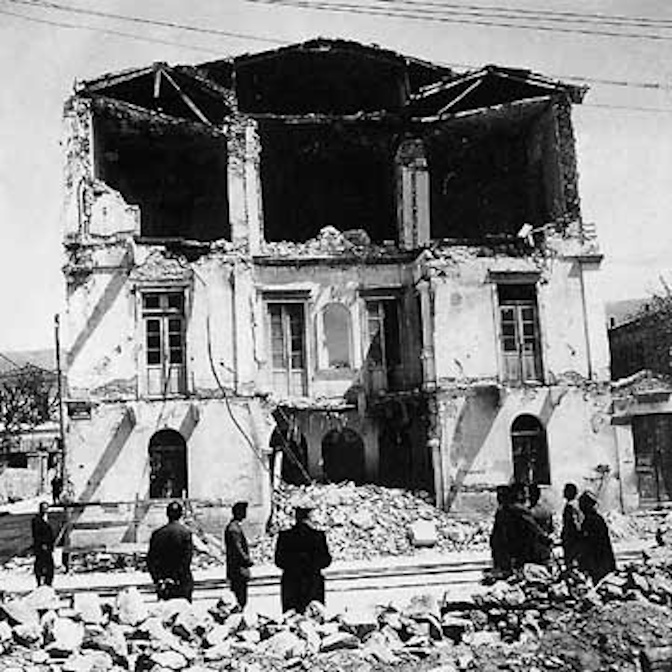
In the post-war period, Volos developed into one of Greece’s most significant urban centres, from both an economic and demographic perspective. In May 1947, the Municipality of Nea Ionia, Volos, was established by royal decree. On 26 February 1954, the Municipal Council of the Municipality of Pagasa decided to rename the municipal authority the ‘Municipality of Volos’. The following year, two earthquakes, on 19 April and 21 April 1955, destroyed almost a quarter of the buildings, and the city’s appearance was transformed. Some of the neoclassical buildings of pre-war Volos were lost forever, and in their place sprang up small post-earthquake houses. These beautiful post-earthquake detached houses were replaced during the era of land swaps (1970–2000) by blocks of flats.
 |
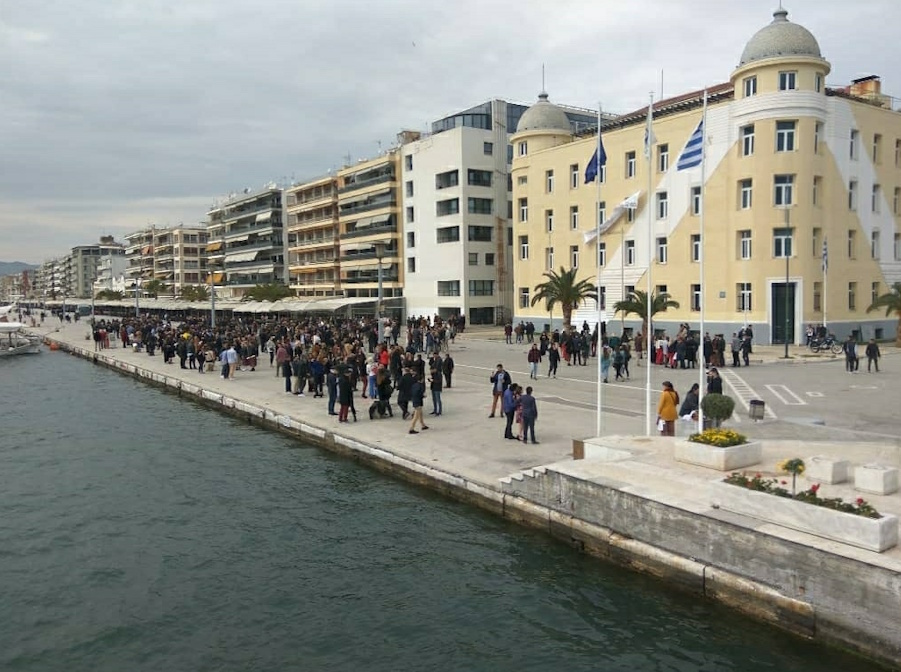 |
Left: A neoclassical building in Volos following the 1955 earthquakes
Δεξιά: The University of Thessaly
Modern times
The industrial growth experienced by Volos up until the early post-war years did not continue at the same pace during the second half of the 20th century. Large factories such as the Matsangos tobacco factory, the Glavanis and Stamatelopoulos ironworks, the Loulis roller mills in Palia (now the Village multi-purpose venue), the Papageorgiou textile mill, the Tsalapata brickworks, and others ceased operations. The operation of the Industrial Zone from 1969 led to a temporary industrial boom with the establishment of new industries. However, by the mid-1980s, the deindustrialisation of Volos had become a reality.Today, a number of large industrial plants continue to operate in the area, such as the Olympus plant of AGET Heracles, Hellenic Steel (formerly Thessaly Steel), VPI’s PET resin plant, Konti’s steel sheet plant, the EPSA bottling plant, Eurika with its detergents, the Hellenic Railways Organisation’s heavy maintenance and refurbishment plant, Papadopoulos biscuits, and others. However, Volos’s economy now relies primarily on trade, services and tourism, and secondarily on small-scale manufacturing and industry.
The University of Thessaly was founded in 1984, with its main campus in Volos and faculties or departments in all the towns of Thessaly. The University, which admitted its first students in 1989 and today has around 15,000 students and over 500 members of academic and technical staff, has breathed new life into the cultural scene of Volos. The Municipal Theatre, the Conservatoire and the city’s Symphony Orchestra are the main centres of artistic activity.
In 2004, Volos became an ‘Olympic city’ after hosting a number of football matches as part of the Olympic Games. The matches took place at the new, state-of-the-art Panthessaliko Stadium, which was built specifically for the Olympic Games. Building on the experience of the 2004 Olympic Games, Volos organised the 27th European Men’s and Junior Artistic Gymnastics Championships and part of the World Billiards Championships in 2006.
 |
 |
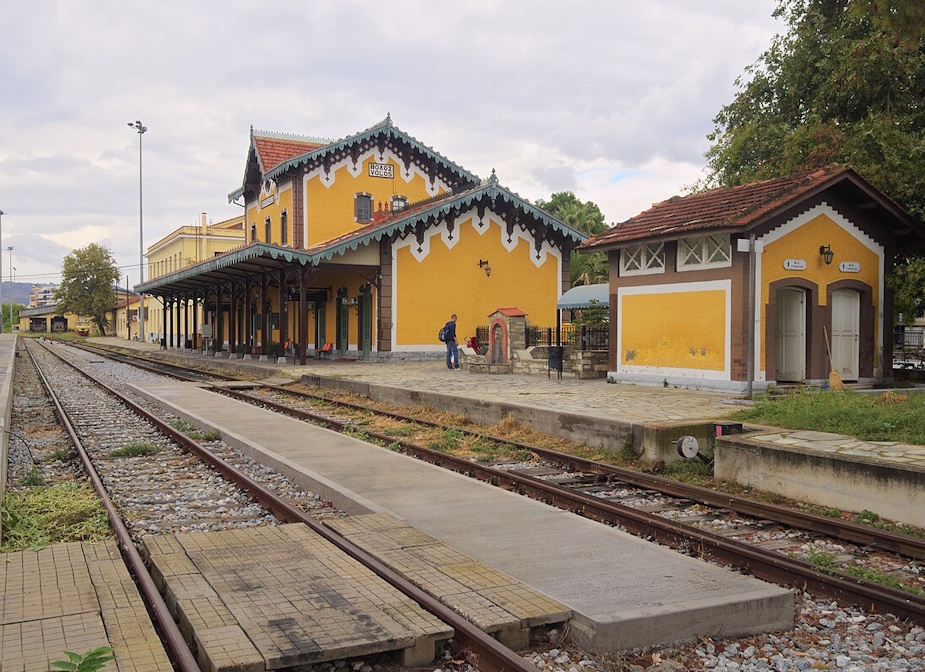
Left: Volos railway station
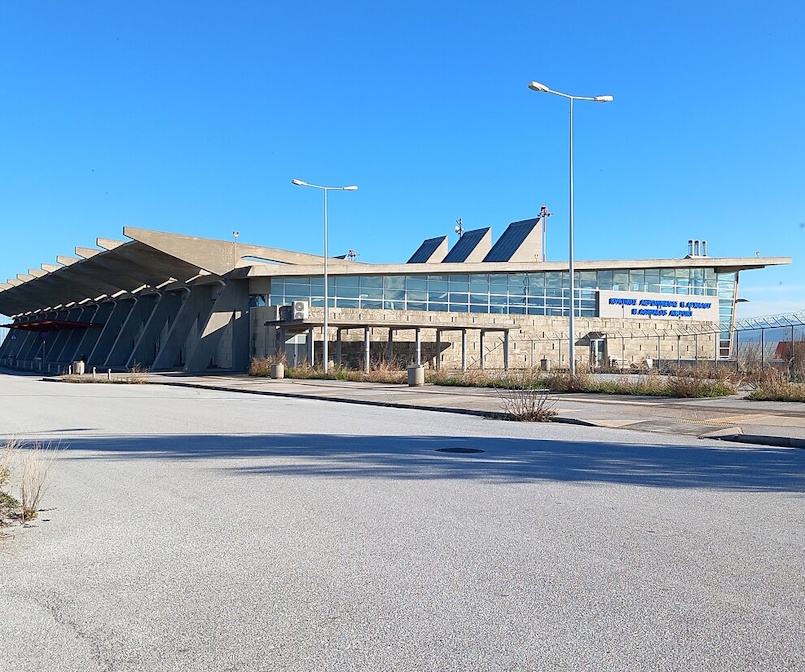
Right: Nea Anchialos State Airport
Places of interest
Volos Castle, in what is now the Palia neighbourhood in the western part of the city, was built in the mid-6th century AD. In the Palia neighbourhood and in the underground car park of the Village multi-purpose venue, visitors can admire the impressive Roman Baths, which have been restored by the Archaeological Service.Le parc d'Anavros, situé en face du musée, présente des exemples représentatifs de la sculpture moderne. En 1988, un symposium réunissant des artistes-sculpteurs grecs et étrangers s'est tenu dans la ville. Les participants ont fait don à la ville des œuvres qu'ils avaient créées pendant la durée du symposium, et qui ornent aujourd'hui le parc.
The House with the Rose, at the junction of Anthimos Gazis and Vlachava Streets, where the painter Chrysoula Zogia lived.
Goritsa, a low hill 200 metres high, jutting out towards the sea from the Pelion mountain range, from where one can overlook the surrounding area and the Pagasetic Gulf, and for this reason it has held an important strategic position since the 4th century BC.
Volos Railway Station was built in 1884 by the Italian engineer Evaristo De Chirico, father of the great surrealist painter Giorgio De Chirico.
Volos Municipal Conservatoire, built in 1885, 1 Metamorfosis Street, Volos. It was originally built to house the operations of the Bank of Epirus and Thessaly, then, from 1900, those of the National Bank of Greece, and finally those of the Volos Municipal Conservatoire.
Tsikrikis Clinic and Residence (formerly the A. Glavanis residence), Year of Construction: 1929, Architect: A. Metaxas, Iasonos & Gambeta, Volos
The Katsemis House (now KETHEA), built in 1929–30, designed by I. Tsirangelos, 18 Metamorfosis Street, on the corner of Sophocleous Street, Volos
Matsangos Tobacco Factory: The original building was constructed in 1890 at the junction of P. Mela and Sokratous streets. The second phase of expansion took place in 1918, and the third, modernist extension covers the block bounded by Makedononachon Street and Sokratous Street, extending as far as 28th October Street; today it houses the Department of Economics at the University of Thessaly.
Former Papastratos Tobacco Warehouse (Rector’s Office of the University of Thessaly), Built between 1926 and 1935, Argonauton Street, Volos
The Chapel of the Holy Trinity at Achillopouleio Hospital, featuring icon paintings by Giorgos Gounaropoulos.
Culture
Museums
The Volos City Museum tells the story of the city of Volos and the refugee town of Nea Ionia through rare photographic material, audio testimonies and selected artefacts. It also hosts unique temporary exhibitions throughout the year, covering all academic disciplines and periods of local history. The Museum is a model of its kind throughout Greece and has been awarded a prize by the Benaki Museum. In addition, it offers organised guided tours.The Archaeological Museum of Volos, which houses finds from the wider region of Magnesia (Iolkos, Ferrai, Demetriada) dating from prehistoric times right up to the Roman period.
The Volos Natural History Museum is situated at 1 Mikrasiaton Street, on the corner with Zachou Street, and houses rocks, minerals and fossils from Thessaly and Greece in general.
The Centre for Asia Minor Culture, ‘The Home of the Ionians’, run by the Cultural Association of Asia Minor Greeks of Nea Ionia, Magnesia, ‘Iones’ (68 Chr. Loulis Street).
The ‘Giorgio de Chirico’ Art Centre, featuring regular themed exhibitions and a permanent collection.
The Museum of Industrial History, in the Tsalapata complex, on the site of the former brick and tile factory of the same name, in the Palaia district. It comprises 20 craft workshops, exhibition spaces and small shops selling traditional local products, venues for exhibitions and artistic events, a library, a video-wall room and a cinema, as well as leisure facilities (café, restaurant, ouzo bar).
The Kitsos Makris Folklore Centre is housed in the folklorist’s home, at 38 Kitsos Makris Street, and belongs to the University of Thessaly. It comprises the folklore collection of this eminent researcher, featuring exhibits that are unique in their kind, his library of 4,000 volumes and his archive, containing 2,500 slides and 4,000 photographs, many of which depict treasures of our folk tradition that no longer survive today.
The Entomological Museum in Volos is the only one of its kind in Greece and is regarded as one of the most notable in the Balkans. It houses 35,000 insects of various orders, mainly Lepidoptera, representing more than 10,000 species, subspecies and races.
The Printing Museum of the newspaper *I Thessalia*, which has been published continuously since 1898, is a unique printing museum. A 350-square-metre hall within the newspaper’s premises, in the Volos Industrial Area (V.I.P.E.), houses a century of history and technological developments.
The Thessaly Railway Museum.
The Library of the ‘Three Hierarchs’ Association is the oldest library in the city of Volos and was the only one from 1907 until 1980. The core of the ‘Three Hierarchs’ library, in its early years, was the archive of Zosimas Esfigmenitis. Gradually, of course, the library was enriched by donations from other scholars, who bequeathed their personal libraries to the Association. Consequently, the Association’s library now comprises a vast number of books, rare manuscripts, incunabula, as well as the complete collection of newspapers published in Volos from 1898 onwards.
The Kontou House – Theophilos Museum in Anakasia. The mansion dates from the first half of the 19th century. It was originally owned by the Hatzianastasi family until 1905, when it was purchased by Yiannis Kontos, a miller from Anovolios. The new owner immediately set about modernising the residence and adapting it to the neoclassical styles of the time. In 1912, according to an inscription, a programme of decorative painting of the top-floor hall was commenced by the great folk painter Theophilos Hatzimichael. The earthquakes of 1955 caused extensive damage to the building. In 1962, in order to protect this monument – unique to the region – the Ministry of Culture designated it a ‘listed historic monument’, and in 1965 it purchased the building so that it could be restored and opened to the public.
The refurbished “Vangelis Papathanassiou” Municipal Theatre in Volos, which opened during the 2023 Christmas holidays.